| Pump Type |
Selection must match the wastewater characteristics and installation method. |
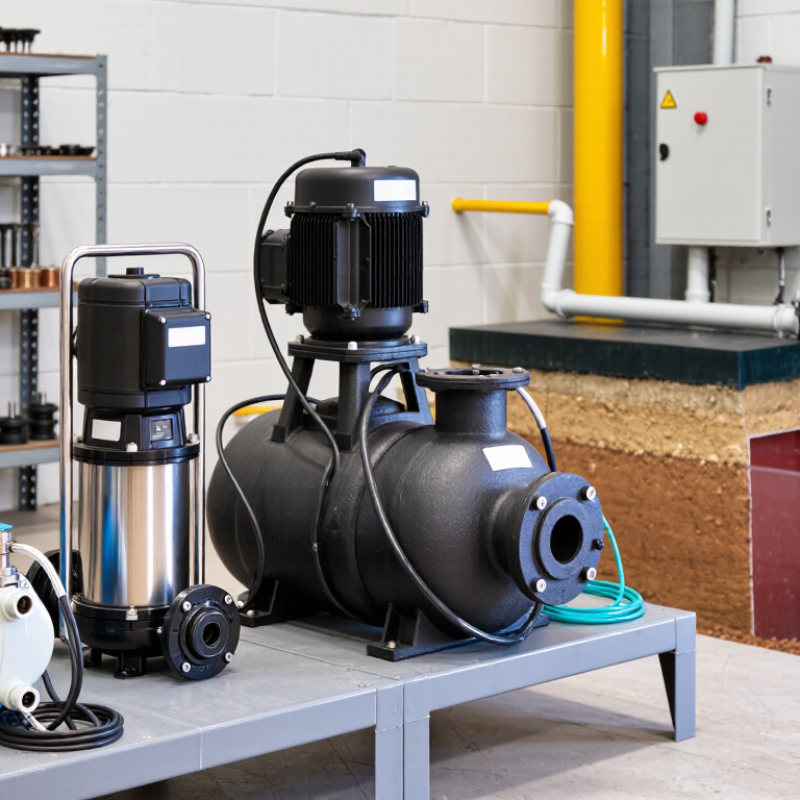
- Submersible sewage or effluent pump
- Vortex or non-clog impeller for solids-bearing wastewater
- Grinder pump where a controlled discharge line and smaller solids are required
|
Technical datasheet, sectional drawing, impeller description, solids-passage specification, and installation manual. |
Product descriptions should clearly distinguish sewage, effluent, drainage, and clean-water pumps. These categories are not interchangeable. |
| Hydraulic Performance |
Performance should be stated using a certified or repeatable pump curve. |
Flow rate: commonly specified in L/min, m³/h, or US gpm.
Head: stated in metres or feet at the corresponding flow rate.
Buyers should evaluate the duty point rather than maximum flow or maximum head alone.
|
Head-flow curve, efficiency data where available, rated duty point, and test conditions. |
Ensure the curve uses the same voltage, frequency, impeller diameter, fluid density, and discharge pipe assumptions as the offered model. |
| Solids Handling |
Solids-passage capacity must be suitable for the expected wastewater. |
Common commercial specifications may include a free passage of approximately 20–75 mm, depending on pump type and application. The required value depends on the local plumbing and wastewater design. |
Manufacturer-declared solids-passage measurement, test method, and recommended installation limits. |
Do not compare free-passage values without confirming whether the measurement refers to spherical solids, fibrous material, or an open impeller passage. |
| Motor and Electrical Supply |
Electrical ratings must correspond to the destination market and the declared product configuration. |
Typical supply configurations include:
- 230 V, 50 Hz for many European and other markets
- 230 V, 50 Hz for the United Kingdom
- 120 V or 208/230 V, 60 Hz for North American applications
- 230 V, 50 Hz for Australia and New Zealand
|
Rated-voltage label, frequency, full-load current, starting current, wiring diagram, and motor-protection requirements. |
Voltage and frequency differences can change motor speed, current, starting performance, and pump output. The importer should verify compatibility before ordering. |
| Ingress Protection |
IEC 60529 is the recognized reference for IP enclosure ratings. |
Submersible pumps are often specified with IP68, but the actual permissible immersion depth and duration must be defined by the manufacturer. |
IP test report or declaration, product label, cable-entry specification, and maximum immersion conditions. |
IP68 is not a universal immersion-depth guarantee. Buyers should request the exact test or operating condition associated with the rating. |
| Electrical Safety |
IEC 60335-1 and IEC 60335-2-41 are commonly referenced for household and similar electrical pumps, where applicable to the product scope. |
Assessment generally covers protection against electric shock, abnormal operation, heating, moisture, mechanical hazards, and construction-related risks. |
Applicable test report, risk assessment, wiring diagram, insulation information, and protective-device requirements. |
The applicable standard depends on the product design, intended use, and destination market. A general “CE certificate” alone does not replace technical compliance evidence. |
| European Union Compliance |
Common regulatory considerations include:
- Low Voltage Directive 2014/35/EU, where within scope
- EMC Directive 2014/30/EU, where within scope
- RoHS Directive 2011/65/EU and amendment 2015/863, where applicable
- Restriction of substances and electrical safety documentation
|
Electrical pumps sold in the European Economic Area may require CE marking when covered by applicable legislation. |
EU Declaration of Conformity, technical file references, test reports, product label artwork, user instructions, and importer information. |
CE marking is a manufacturer’s conformity declaration, not a quality grade and not necessarily a third-party certification. |
| United Kingdom Compliance |
Products placed on the Great Britain market may require UKCA compliance under applicable UK regulations; CE recognition may also apply during the relevant transition arrangements. |
Electrical safety, electromagnetic compatibility, product labeling, and technical documentation should be reviewed for the intended UK market. |
UK Declaration of Conformity or applicable conformity documentation, English instructions, label information, and importer details. |
Requirements differ between Great Britain and Northern Ireland. The importer should confirm the current route before shipment. |
| North American Requirements |
Requirements may involve national electrical codes, local inspection rules, and recognized product safety certification. |
Depending on the installation, buyers may request evaluation to relevant pump safety standards such as UL 778 or applicable Canadian requirements. |
Recognized laboratory certification, listing information, electrical ratings, installation instructions, and cord or plug specifications. |
Certification requirements vary by country, state, province, utility, and installation authority. A CE mark is generally not a substitute for North American acceptance. |
| Australia and New Zealand |
Electrical equipment may be subject to local electrical safety, electromagnetic compatibility, and supplier registration requirements. |
Product configuration, plug type, rated voltage, cable, and installation instructions should match the destination market. |
Applicable conformity evidence, supplier information, electrical test reports, and locally required labeling. |
Confirm whether the product falls under an applicable mandatory or voluntary approval category before importation. |
| Wastewater Installation Standards |
Building drainage and lifting-station requirements are determined by local plumbing and construction rules. |
In Europe, EN 12050-1 covers lifting plants for wastewater containing faecal matter, while EN 12050-2 covers lifting plants for faecal-free wastewater. EN 12056-4 addresses gravity drainage systems inside buildings. |
Installation manual, system layout, non-return valve requirements, alarm details, venting information, and maintenance instructions. |
These standards do not automatically certify every pump. The complete lifting station and installation must be assessed against the applicable local requirements. |
| Materials and Corrosion Resistance |
Materials should be compatible with wastewater, temperature, chemicals, and the expected service environment. |
Common materials include cast iron, stainless steel, engineering plastics, elastomers, and oil-resistant cable compounds. |
Material declaration, corrosion-resistance information, seal material, cable material, and wastewater compatibility statement. |
Material suitability depends on pH, chlorides, cleaning chemicals, temperature, and exposure time. Stainless steel does not provide universal chemical resistance. |
| Seal and Bearing Arrangement |
Mechanical seals, bearings, and motor protection should be selected for continuous or intermittent wastewater duty. |
Typical features may include tandem mechanical seals, oil-filled seal chambers, thermal overload protection, and permanently lubricated bearings. |
Seal material, bearing specification, thermal-protection method, service interval, and warranty conditions. |
Buyers should verify whether thermal protection is built into the motor or must be provided externally by the control panel. |
| Controls and Level Detection |
Automatic operation should prevent dry running, overflow, excessive cycling, and unsafe starting conditions. |
Common arrangements include float switches, pressure or level sensors, control panels, high-level alarms, and manual-reset overload protection. |
Control-panel wiring diagram, float-switch rating, alarm output, minimum sump dimensions, and pump-start frequency limits. |
Control components may require separate approvals from the pump. Confirm whether sensors and panels are included in the quoted supply. |
| Energy and Operating Cost |
Energy consumption should be evaluated at the actual duty point, not only by motor nameplate power. |
Compare hydraulic efficiency, motor input power, operating hours, starts per hour, and expected annual wastewater volume. |
Pump curve, input-power data, motor efficiency information where available, and estimated lifecycle-cost calculation. |
A lower purchase price may result in higher operating cost if the pump is oversized, inefficient, or poorly matched to the discharge system. |
| Noise and Vibration |
Noise and vibration should be controlled through correct installation, alignment, pipe support, and pump selection. |
Submersible installation normally reduces airborne noise, but hydraulic turbulence, check-valve slam, and pipe vibration may remain. |
Installation instructions, vibration limitations, recommended pipe supports, and acoustic data when available. |
Noise measurements should specify distance, test environment, mounting condition, and operating point because results are installation-dependent. |
| Factory Testing and Quality Records |
Each production unit should be traceable to a defined model, batch, and test procedure. |
Useful checks include insulation resistance, dielectric strength where applicable, leakage, rotation, current draw, hydraulic performance, and functional operation. |
Routine test report, serial-number traceability, inspection checklist, calibration records, and nonconformity procedure. |
For large orders, buyers can specify pre-shipment inspection, sampling plans, witnessed testing, and retention of test records. |
| Marking and User Documentation |
Product markings must be durable, legible, and consistent with the conformity documentation. |
Important information includes model, serial number, rated voltage, frequency, power, current, IP rating, phase, rotation information, and manufacturer or importer details. |
Rating plate artwork, multilingual manual, declaration of conformity, safety warnings, spare-parts list, and installation instructions. |
Language requirements vary by destination. English-only documentation may not satisfy every market or local authority. |
| Export Packaging |
Packaging must protect the pump, cable, float switches, control equipment, and machined connection surfaces during transport. |
Recommended controls include shock protection, moisture protection, cable protection, corrosion prevention, lifting-point protection, and secure accessory packing. |
Packing list, package dimensions, gross and net weights, photographs of packed goods, and handling instructions. |
Wood packaging used in international trade may need to comply with ISPM 15 treatment and marking requirements. |
| Shipping and Customs Information |
Customs classification depends on the pump design, operating principle, liquid handled, and national tariff interpretation. |
Liquid pumps are commonly considered within HS heading 8413, but the final subheading must be confirmed for the specific product and importing country. |
Commercial invoice, packing list, bill of lading or airway bill, certificate of origin where required, technical description, and customs classification support. |
Do not rely on a generic HS code without confirmation from a customs broker or the destination customs authority. |
| Warranty and After-Sales Support |
Warranty terms should define the covered period, exclusions, installation conditions, and evidence required for a claim. |
Important provisions include seal failure, motor failure, cable damage, wear parts, blocked impellers, dry running, incorrect voltage, and unauthorized repairs. |
Written warranty, spare-parts list, troubleshooting guide, service procedure, response time, and replacement policy. |
Global buyers should verify access to seals, impellers, float switches, capacitors, control components, and compatible replacement parts. |
| Buyer Pre-Shipment Checklist |
The selected pump should be validated against the complete duty and compliance profile before mass production. |
- Confirm flow, total dynamic head, solids size, liquid temperature, and duty cycle
- Confirm voltage, frequency, phase, cable length, plug, and control method
- Verify applicable destination-market standards and markings
- Review test reports, declarations, manuals, labels, and packaging
|
Approved technical submittal, signed specification sheet, sample inspection report, conformity documents, and final packing approval. |
Final compliance responsibility may involve the manufacturer, importer, distributor, installer, and local authority. Assign responsibilities contractually before shipment. |