231-941-0215 sale@namkeenmachine.com 2707 Aero Park Drive Traverse City, MI
Eng
  • Eng
  • Deu
  • Fra

Why Choose 10G SFP Copper for Your Network?

Network upgrades rarely happen on a clean slate. A rack may hold fiber uplinks, legacy Cat6 runs, and switches with only a few open SFP+ ports. In that setting, 10g Sfp Copper can connect compatible equipment to existing twisted-pair cabling without replacing every cable. Cisco’s Annual Internet Report projected global IP traffic would reach 396 exabytes per month by 2022. That forecast is not a current measurement, but it captures the pressure behind faster, denser networks.

Reach depends on the link, not just the label. IEEE 802.3an specifies 10GBASE-T over Cat6A cabling for distances up to 100 meters. By contrast, SFP+ 10GBASE-T modules often support shorter runs; Cisco lists up to 30 meters for its SFP-10G-T-X module. Check the module datasheet, cable category, switch compatibility, and port power limits before ordering. Small details matter.

Copper can make practical sense for short connections to servers, storage, or nearby switches. It uses familiar RJ45 cabling and can simplify moves in an existing copper plant. Yet it is not automatically cheaper or cooler: 10GBASE-T modules may draw more power and generate more heat than direct-attach copper or optical alternatives. That trade-off deserves a rack-level check. A crowded switch can tell a different story than a quote sheet. The right choice depends on distance, airflow, and what the installed equipment supports—not on the word “copper” alone.
Why Choose 10G SFP Copper for Your Network?

What Is a 10G SFP Copper Transceiver?

A 10G SFP copper transceiver is a compact module that plugs into an SFP+ port and provides an RJ45 connection for twisted-pair Ethernet cable. It converts signals between the switch and a copper link, letting compatible network equipment connect without fiber. For teams using existing copper cabling, that can simplify upgrades and keep familiar patch leads in place. Still, “SFP copper” does not guarantee every module works in every port.

The IEEE 802.3an specification defines 10GBASE-T operation over Cat6A cabling for links up to 100 meters. That distance describes the cabling standard, not necessarily the reach of a particular SFP+ module. Many compact modules have shorter specified ranges and can generate substantial heat. A useful check: confirm the module’s supported distance, port compatibility, cable category, and operating temperature before deployment. One detail is easy to miss.

Tips: Measure the actual cable path, including patch panels. Check the switch’s power and temperature limits, too. Don’t assume Cat6A alone solves compatibility; the transceiver and host port must support the same interface. IEEE specifications provide a dependable baseline, but product-level limits still matter.

How Does 10G SFP Copper Connect to Network Devices?

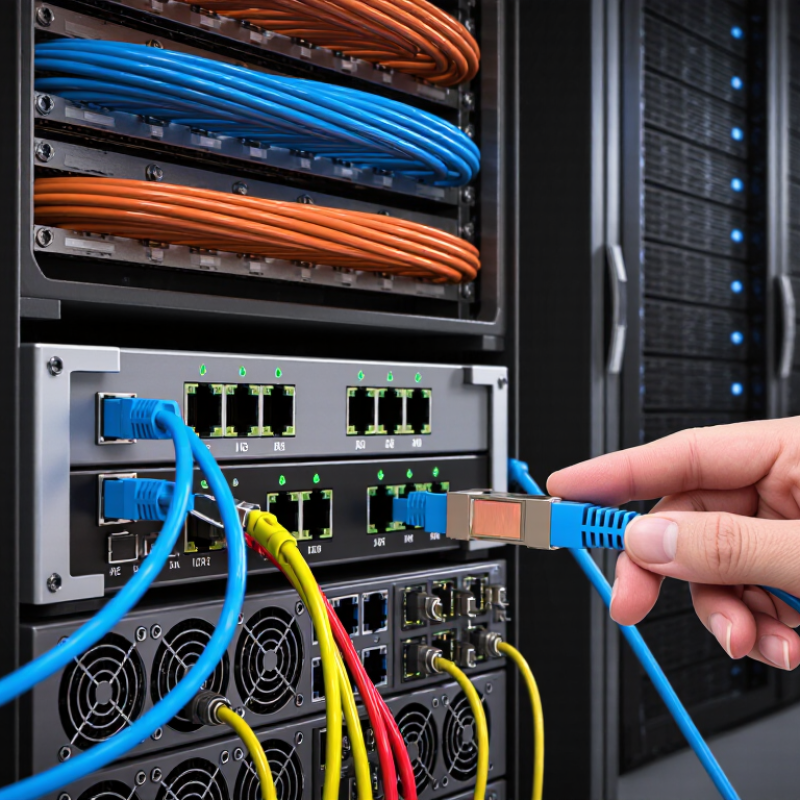
A 10G SFP copper connection usually starts at an SFP+ port on a switch, router, or server. A copper transceiver clicks into the port, then an RJ45 Ethernet cable runs to the network device. The connection may look ordinary, but the module must match the port’s supported speed and specifications. Check the device documentation before installation; not every SFP+ port supports every copper module.

For a 10GBASE-T module, use suitable twisted-pair cabling, such as Cat6a, and confirm the module’s supported cable length. The module converts signals between the SFP+ interface and Ethernet copper. It can also generate more heat than an optical module, especially in a tightly packed switch. In practice, neat cable routing is not always possible, but avoid blocking vents. A direct-attach copper cable is another option: it connects two SFP+ ports directly and does not use RJ45 sockets.

Tips: Confirm both ends support 10Gbps, seat the module firmly, and inspect the port status after connecting. If the link stays down, check cable seating, speed settings, and module compatibility before replacing hardware. One overlooked detail can waste an afternoon.

What Benefits Does 10G SFP Copper Offer?

10G SFP copper modules give a switch with an SFP+ port a familiar RJ45 connection for twisted-pair Ethernet. They can reuse installed cabling, avoiding new fiber runs through short office routes or equipment racks. No fiber needed. A technician can connect a server to a switch using the same copper leads already used by nearby devices.

The practical benefit is flexibility. A mixed network may contain fiber uplinks and copper-connected servers; a suitable copper module lets those links coexist. In a rack, short patch cables can simplify maintenance and moves. Copper links are also easy to trace and replace. That matters. With common 10GBASE-T modules, supported reach depends on the module, cable category, and host device. Many SFP+ copper modules are designed for short runs, often up to about 30 meters, rather than every building-wide connection.

There is a trade-off, though. Copper modules can use more power and run warmer than some optical alternatives, so check the switch’s compatibility list and thermal limits before deployment. A crowded switch may need extra airflow. For longer distances or dense installations, fiber may be a better fit. The right choice depends on distance, existing cabling, and operating conditions. Some details are easy to overlook.

Where Is 10G SFP Copper Commonly Used?

10G SFP copper is commonly used to connect servers, storage appliances, and switches over existing twisted-pair cabling. In a compact server room, an RJ45 SFP+ module can link a 10G-capable server to a nearby switch without adding fiber. It also suits small data-center rows, enterprise wiring closets, and short links between network cabinets. Short runs matter.

Synergy Research Group counted more than 1,000 operational hyperscale data centers worldwide by the third quarter of 2024. Separately, the 2018–2023 Annual Internet Report forecast global IP traffic would reach 5.3 zettabytes in 2023, nearly three times its 2017 level. These figures point to growing network demands, but they do not mean copper fits every connection. Many 10GBASE-T SFP+ modules are rated for up to 30 meters, depending on the module and cable. Check both limits before installation. Copper can reuse existing cabling, which is convenient, but these modules may run hotter and use more power than fiber alternatives. For long runs or dense switch racks, that trade-off deserves a closer look.

Why Choose 10G SFP Copper for Your Network? - Where Is 10G SFP Copper Commonly Used?

Common Use Typical Connection Typical Cable Typical Reach Why Use 10G SFP Copper? Key Consideration
Server-to-switch links in a rack 10G SFP+ switch port to a 10GBASE-T server interface Cat 6 or Cat 6A twisted-pair Ethernet Often up to 30 m for an SFP+ 10GBASE-T module; check the module specification Connects to existing RJ45 server ports without replacing the server network interface Confirm supported cable category, module reach, and host-port compatibility
Switch-to-switch links in a wiring closet SFP+ uplink to a 10GBASE-T port on another switch Installed Cat 6A or suitable Cat 6 cabling Within the distance rating of the module and cable; commonly up to 30 m for SFP+ copper modules Uses existing structured cabling and RJ45 interfaces for short uplinks Do not assume the 100 m reach associated with some 10GBASE-T installations applies to an SFP+ module
Short links in a server room or lab 10G SFP+ port to a compatible RJ45 device Copper Ethernet patch cable, typically Cat 6A A few metres to the module’s specified maximum Provides a convenient way to connect equipment with copper Ethernet ports Check power consumption and heat, especially when several modules are installed in one switch
Network upgrades using existing copper runs SFP+ switch port connected to an existing 10GBASE-T endpoint Existing twisted-pair cabling, after verifying its category and condition Limited by the cable installation and the SFP+ module specification Can help reuse copper infrastructure instead of installing a new fiber link for a short connection Test the cabling and verify that both devices support the required 10GBASE-T connection
Temporary or frequently changed connections SFP+ switch port to a nearby RJ45 device Standard Ethernet patch cable of the required category Short runs within the module’s rated distance RJ45 cabling is widely available and easy to connect or replace For longer runs or dense, high-port-count deployments, compare heat, power, and reach with fiber alternatives

Note: Reach and compatibility vary by module, switch, cable category, and installation conditions. Check the equipment specifications before deployment.

What Factors Matter When Choosing a 10G SFP Copper Module?

Why Choose 10G SFP Copper for Your Network?

What Factors Matter When Choosing a 10G SFP Copper Module?

A 10G SFP copper module can connect an SFP+ switch port to familiar RJ45 cabling. It may suit a rack where copper runs already reach servers or storage devices. Before buying, confirm that the switch supports the module type. Check its datasheet for host compatibility, supported link speeds, and power requirements. Some modules use more power and generate more heat than optical alternatives, which matters in a tightly packed switch.

Cable reach is another key factor. Many 10GBASE-T SFP+ modules support runs up to 30 meters over suitable Cat6a cable, but limits vary by module. Confirm the cable category, connector condition, and distance at the actual installation site. Also check whether both ends can negotiate the same speed. The choice is rarely perfect on paper; rack temperature and airflow can affect real-world stability.

Tips: Check the datasheet. Test one link before deploying widely. Watch for heat around the module after several hours of traffic. If the connection drops, inspect the cable and port settings before replacing hardware. A small detail, but useful.

Why Choose 10G SFP Copper for Your Network?

What Factors Matter When Choosing a 10G SFP Copper Module?

Reach is an important selection factor: 10GBASE-T can run up to 100 m over Cat6A cabling, while Cat6 may support up to 55 m under suitable installation conditions. Many SFP+ 10GBASE-T copper modules are limited to about 30 m. Check the module datasheet, cable category, power requirements, and switch compatibility before choosing.

Article Source: