231-941-0215 sale@namkeenmachine.com 2707 Aero Park Drive Traverse City, MI
Eng
  • Eng
  • Deu
  • Fra

What Is a Vacuum World in Artificial Intelligence?

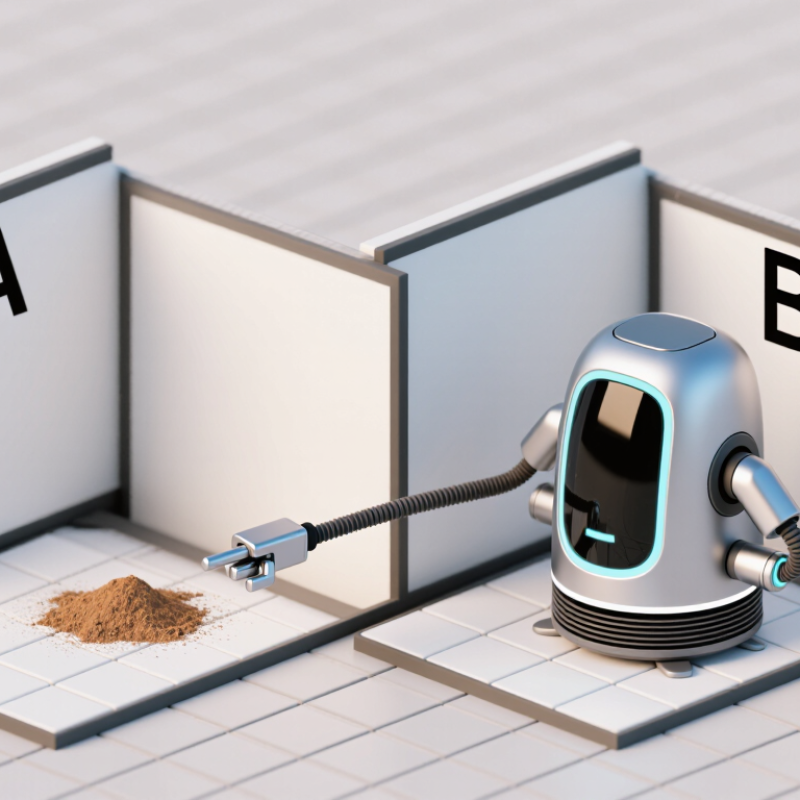
A vacuum world is one of artificial intelligence’s simplest test environments, but its small scale makes important ideas visible. Imagine two rooms, A and B, a patch of dust on the floor, and an agent that can move or clean. The setup lets researchers ask a practical question: can an agent choose useful actions from limited information? Stuart Russell and Peter Norvig describe the classic example in Artificial Intelligence: A Modern Approach: “The vacuum-cleaner world is a simple environment consisting of two locations: squares A and B.” That concise description anchors a model used to explain agents, perceptions, actions, and performance measures.

The model can be extended. A vacuum agent might sense dirt only in its current square, remember what it has seen, or face a battery that runs low. Each change tests a different capability, from reflex behavior to planning under uncertainty. The floor is tiny. The reasoning is not always. A clean result alone may not show whether the agent acted efficiently or merely got lucky. That distinction matters when evaluating intelligent systems.

The vacuum world is deliberately abstract, so it cannot capture every detail of a real home, such as tangled cables, furniture, or changing room layouts. This is a limitation worth keeping in view. Still, its clear rules make it a reliable starting point for studying how an AI agent perceives its environment, selects actions, and measures success.
What Is a Vacuum World in Artificial Intelligence?

Definition and Core Idea of a Vacuum World

A vacuum world is a small, artificial environment used to explain how an intelligent agent makes decisions. Picture two rooms, A and B, with dust on the floor and a vacuum agent moving between them. The agent may sense its current location and whether that room is dirty. It can move left, move right, clean, or stop. Simple setup.

The world’s core idea is its model: possible states, available actions, percepts, and rules for how actions change the environment. With two rooms, each either clean or dirty, and the agent in either room, there are eight possible states. The agent follows a policy that maps what it senses to an action. Its goal might be to clean both rooms, while a performance measure rewards clean floors and penalizes wasted movement or energy. Change the scoring rule, and the preferred behavior may change.

The classic version often assumes clear rules and predictable actions. Actual homes contain rugs, furniture, scattered crumbs, and sensors that miss patches of dust. Those details are omitted on purpose, but the omission can hide important failure modes. An agent that marks a room clean too early may simply have missed dirt. Models are useful. Testing assumptions matters.

Environment, Locations, and Cleanliness States

What Is a Vacuum World in Artificial Intelligence?

A vacuum world is a small model used to study how an intelligent agent senses and acts. Picture two rooms, A and B, with a narrow doorway between them. Each room can be clean or dirty, and the agent occupies one location at a time. Simple, but useful.

The environment is described by its layout, the agent’s position, and each location’s cleanliness state. A sensor might report “in A, dirt present,” while an action could move the agent or clean the current room. The agent does not necessarily know the whole world at once. Its decisions depend on what it can sense and remember. In a basic version, rooms stay still until the agent changes them. Real environments are messier.

This model helps explain how rules connect perception with action. If the agent senses dirt nearby, it may clean; if its current room is clean, it may move elsewhere. A performance measure might reward clean rooms and penalize wasted movement. That choice matters: an agent optimized only for cleanliness could keep cleaning forever. The model also leaves details out, such as obstacles, sensor errors, or dirt appearing again. That simplification is useful, though it can make the agent seem smarter than it would be in a real home.

Vacuum World: Possible States by Number of Dirty Locations

In a two-location vacuum world, each location can be clean or dirty, and the agent can be in either location. This creates 8 possible states: 2 with no dirty locations, 4 with one dirty location, and 2 with both locations dirty.

Sensors, Actions, and Agent Rules

What Is a Vacuum World in Artificial Intelligence?

A vacuum world is a small model used to explain how an intelligent agent senses and acts. Picture two rooms, A and B, with dust on the floor. The agent’s sensors might report its current room and whether that room is clean or dirty. It usually cannot inspect every room at once. Small clues matter.

Actions are simple: move left, move right, suck up dirt, or stay still. The agent uses rules to connect a sensor reading to an action. For example, “If the current room is dirty, then suck.” If the room is clean, a rule might tell the agent to move elsewhere. That sounds simple. Yet a rule can fail when the agent reaches a wall or has already cleaned both rooms.

Agent rules make the model useful because they show how decisions depend on available information. A basic rule might clean each room, then stop. A more careful agent tracks where it has been, though that requires memory beyond the immediate sensor reading. In a real environment, sensors can be noisy, and dirt may appear again. The tidy two-room example hides those complications. I find that limitation worth noticing: a rule that works neatly on paper may behave awkwardly when its assumptions change.

How Vacuum Worlds Model Intelligent Decision-Making

A vacuum world is a compact simulation: a small grid, a cleaning agent, and a few dirty squares. The agent senses its current location and whether that square is clean. It can move or clean, but every move costs time or energy. This simple setup exposes the core problem: an intelligent system must choose actions from limited information, then respond to what happens.

A designer can change the room, hide dirt from the agent, or add a battery limit. Each change tests a different decision skill, such as planning, sensing, or balancing effort against reward. Stanford HAI’s 2024 AI Index counted 149 notable foundation models released in 2023; industry produced 65.7% of them. That figure describes a fast-moving field, not proof that larger models make better choices. Small simulations still help researchers inspect behavior step by step. A useful reminder: even a tidy grid leaves out messy real-world details.

Tips: Track each action, the agent’s observation, and the outcome. Test one change at a time. If the agent keeps cleaning an already clean square, check its sensor assumptions before blaming its strategy.

What Is a Vacuum World in Artificial Intelligence? - How Vacuum Worlds Model Intelligent Decision-Making
Model Element Possible Values or Example What the Agent Knows Decision-Making Role Illustrative Result
Environment layout Two locations: A and B The agent can occupy one location at a time. Defines where the agent can perceive and act. If the agent is at A, it can clean A or move to B.
Location condition Each location is either Clean or Dirty. A location’s condition may be known only when it is perceived. Determines whether cleaning is needed. If the current location is Dirty, the agent may choose Suck.
State space 8 possible states in the basic two-location model A state specifies the agent’s location and the condition of both locations. Provides the set of situations the agent’s policy can address. There are 2 possible agent locations × 2 conditions for A × 2 conditions for B.
Percept Current location and whether that location is Clean or Dirty The agent receives information about its current situation; it may not directly observe the other location. Supplies evidence used to select an action. Percept: “At A; A is Dirty” can support choosing Suck.
Action: Suck Clean the current location The agent applies this action where it is currently located. Changes the environment by removing dirt from that location in the basic model. If A is Dirty and the agent is at A, Suck makes A Clean.
Actions: Left and Right Move to the neighboring location when possible The available move depends on the agent’s current location and the model’s movement rules. Lets the agent reach another location and gather information there. From A, moving Right can take the agent to B in the two-location example.
Action: NoOp Take no action The agent may select this when no further action is needed or allowed by its policy. Can represent stopping after the task is complete. If both locations are known to be clean, a policy may choose NoOp.
Agent policy A mapping from percepts (or percept history) to actions A simple reflex policy uses the current percept; a model-based policy can also use stored information. Turns observations into consistent action choices. “If the current location is Dirty, Suck; otherwise move toward the other location.”
Performance measure For example, reward clean locations while accounting for time or action cost The measure defines what counts as successful behavior in a particular task. Guides how competing choices are evaluated. A policy that cleans both locations efficiently can score better than one that repeatedly revisits a clean location.
Modeling note This is a simplified teaching model. Real vacuum environments may include more locations, uncertain sensors, obstacles, changing dirt, and different action costs.

Variations and Limitations of the Vacuum World Model

A vacuum world is a simplified setting for studying how an intelligent agent senses and acts. Picture two rooms, each either clean or dusty, with a vacuum agent moving between them. The agent may detect dirt in its current room, but it cannot necessarily see the whole environment. This small setup makes decision rules easier to inspect.

The model can vary in useful ways. A world might contain a grid of rooms, obstacles, or dirt that appears over time. Sensors may reveal only nearby squares, while movement may sometimes fail or consume energy. These changes test different abilities: planning routes, handling uncertainty, and balancing cleanliness against effort. Even a small change matters. A fixed two-room world rewards simple rules; a larger, changing one may require memory and more careful choices.

Yet the model leaves much out. Real spaces have uneven floors, clutter, and sensors that give noisy readings. A clean-looking tile may still hold dust, and a blocked path can change an agent’s plan. Results from a tidy simulation therefore do not prove that a system will work well in an actual home. I find the model valuable for isolating ideas, but its neatness can become a trap. It may teach us more about the assumptions we chose than about cleaning itself.