Top 10 Types of Logistics Trolleys for Global Buyers
Global buyers rarely choose logistics equipment by appearance alone. They examine load capacity, wheel performance, handle height, storage space, safety features, and total operating cost. Logistics Trolleys may move cartons through a warehouse, parcels across a loading bay, or medical supplies between controlled areas. Each setting creates different demands.
Martin Christopher, a widely respected supply-chain expert, stated, “Competition is no longer between companies, but supply chains.” His observation remains practical today. A reliable trolley can shorten picking routes, reduce lifting strain, and protect goods during busy transfers. However, the wrong model may create noise, damage floors, or slow workers at narrow doors.
This guide introduces the top 10 types of Logistics Trolleys for global buyers. It considers platform trolleys, cage trolleys, folding models, sack trucks, warehouse picking carts, and specialized designs. The comparison focuses on real purchasing concerns, including materials, wheel layouts, braking systems, corrosion resistance, and maintenance access. Small details matter.
A 125-millimeter wheel may cross a smooth warehouse floor easily, yet struggle over a damaged threshold. A steel frame can carry heavy loads, but it may increase handling effort. These trade-offs are easy to overlook. No trolley wins everywhere.
Buyers should also review supplier documentation, testing records, warranty terms, and replacement-part availability. Product names can vary between regions, which sometimes causes confusion. Specifications deserve more attention than attractive photographs. Even experienced purchasing teams can miss this point. The best choice balances worker comfort, product durability, site conditions, and long-term value.
What Logistics Trolleys Are and Why Global Buyers Use Them
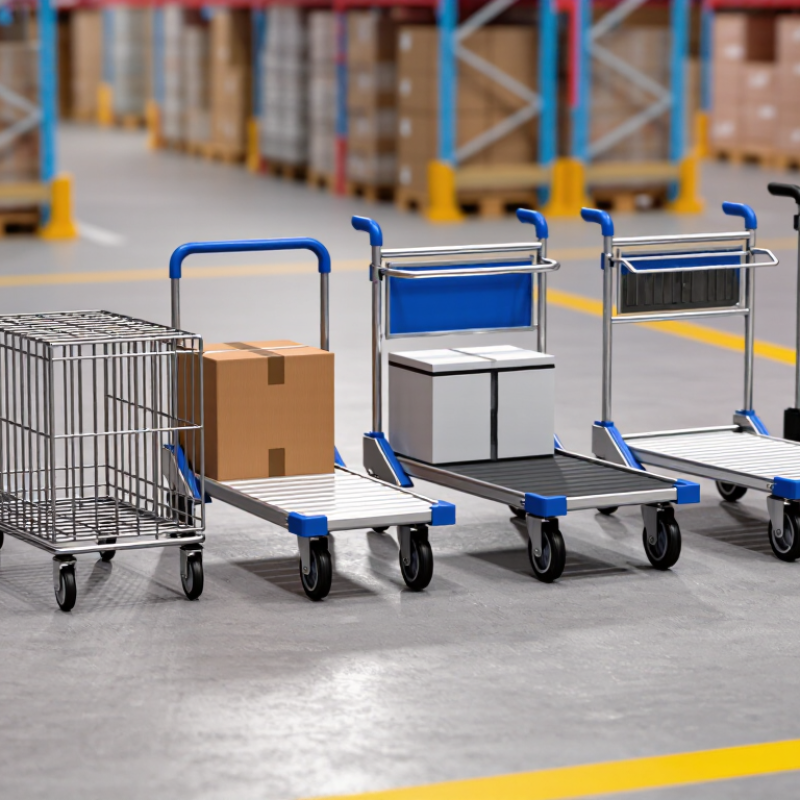
Logistics trolleys are wheeled handling units used to move cartons, bins, tools, or garments across warehouses, stores, and loading areas. They reduce repeated lifting and keep goods closer to the worker. Common designs include platform trolleys, cage trolleys, two-wheel hand trucks, picking carts, roll containers, and folding models. Each serves a different load pattern.
Global buyers use them because internal movement often creates hidden delays. A trolley can shorten walking routes, support batch picking, and reduce handling damage. MHI’s 2024 Annual Industry Report found that 83% of supply chain professionals expect robotics and automation adoption within five years. Basic trolleys remain relevant because they are affordable, flexible, and easy to deploy beside automated systems. They also require less training. That matters in facilities with changing labor teams.
The right choice depends on load weight, aisle width, floor condition, wheel material, and storage height. A cage trolley suits loose parcels, while a platform model handles bulky cartons. In practical warehouse assessments, poor wheel selection often causes more trouble than trolley price. Small wheels struggle on uneven floors. Narrow frames can tip under tall loads. Buyers should test turning radius and brake control with a real load, not an empty sample. This step is easy to skip. It should not be. The World Bank’s 2023 Logistics Performance Index also highlights the importance of reliable logistics processes, where simple handling equipment can support consistent warehouse performance.
Top 10 Types of Logistics Trolleys for Global Buyers
Logistics trolleys are wheeled handling equipment used to move goods safely and efficiently across warehouses, factories, retail facilities, airports, and distribution centers.
The chart compares representative nominal load capacities commonly specified for each trolley type. Actual capacity varies by frame material, wheel design, platform size, and supplier configuration. Global buyers select trolleys according to load requirements, maneuverability, storage efficiency, and operating environment.
Pallet, Bin, and Picking Trolleys for Warehouse Operations
Warehouse trolley selection starts with the load, not the catalogue photo. Pallet trolleys handle heavy, standardized loads across wider aisles. Their forks, wheel size, and turning radius affect daily productivity. A low-clearance frame may fit beneath pallets, but uneven floors can expose weak casters. I have seen operators lose time pushing overloaded units through narrow dock lanes. That small delay becomes expensive.
Bin trolleys suit smaller parts and stacked containers. Adjustable shelves help when inventory sizes change. Picking trolleys need clear labeling areas, stable handles, and smooth movement between storage zones. A shallow upper shelf keeps frequently picked items within reach. Deep bins can hold more, but they also hide misplaced stock. Good design reduces searching.
Durability needs practical checking. Weld quality, coating thickness, wheel bearings, and brake performance matter during repeated shifts. A trolley may pass a showroom test and still fail beside a cold loading door. I once underestimated handle height; shorter workers found the same model uncomfortable. That mistake changed our evaluation process.
Ask suppliers for load ratings, wheel materials, replacement parts, and test records. Confirm aisle width before ordering. Measure the real route, including ramps, thresholds, and lift entrances. A bright finish looks professional, but corrosion resistance and cleanability matter more in busy warehouse operations.
Scissor-Lift, Stair-Climbing, and Heavy-Duty Trolleys
Top 10 Types of Logistics Trolleys for Global Buyers
Scissor-lift trolleys support safer pallet positioning, picking, and workstation transfers. Their raised platforms reduce repeated bending, especially beside low storage racks. The NIOSH Revised Lifting Equation uses a 23 kg load constant under ideal conditions. This is not a universal safe lifting limit. Buyers should check reach distance, grip quality, posture, and travel frequency. A trolley rated for 500 kg may still perform poorly on uneven concrete.
Stair-climbing trolleys suit buildings without reliable lift access. Powered models can move boxed equipment over steps, but landing depth and stair-edge geometry remain critical. The UK Health and Safety Executive’s Manual Handling guidance recommends avoiding hazardous lifting where reasonably practicable. In practice, operators still need training, controlled speed, and a secure load restraint. One missed strap can change a routine delivery into a serious handling problem. Stair trolleys also need compact frames and brakes that hold on sloped landings.
Heavy-duty trolleys serve machinery, warehouse bins, and dense components. Select welded frames, load-rated casters, corrosion-resistant surfaces, and replaceable wheels. ISO 11228 handling guidance highlights the importance of force, distance, and workplace conditions. Buyers should request test methods, not only headline capacity. My practical concern is simple: specifications often describe perfect floors. Real sites contain thresholds, debris, and tight corners. Trial the trolley with the actual load before approving a global purchase.
How to Compare Trolley Types for International Purchasing
Top 10 Types of Logistics Trolleys for Global Buyers
How to Compare Trolley Types for International Purchasing
Global buyers should compare trolley types by task, load, route, and service conditions. Common options include platform, cage, shelf, picking, sack, drum, panel, linen, folding, and stair-climbing trolleys. A platform trolley suits boxed cargo on smooth floors. A cage trolley protects mixed parcels. Shelf and picking models support faster order assembly. Drum and panel trolleys require specialized load control. Folding models save container space, but their joints may wear sooner.
The World Bank Logistics Performance Index 2023 evaluates 139 economies through customs, infrastructure, logistics competence, tracking, and timeliness. These factors also shape trolley selection. Buyers should request wheel diameter, turning radius, frame steel grade, brake design, and rated capacity. Check whether the trolley fits standard doors, lifts, pallets, and storage aisles. Small details matter. A 150-kilogram rating may fail on uneven floors or ramps.
MHI’s 2024 Annual Industry Report highlights continuing investment in automation, robotics, and connected operations. That trend makes compatibility increasingly important. Choose handles and heights that support safe worker movement. Measure folded dimensions before comparing shipping costs. Ask for load tests, corrosion data, replacement-part availability, and inspection records. I would not trust attractive catalog photos alone. A cheaper trolley can become expensive after damaged wheels, poor documentation, or difficult spare-part sourcing. Local operating habits also deserve review; a technically strong choice may still perform badly in crowded facilities.