2026 Top 5 Axis Wood CNC Machines for Global Buyers
The 2026 market for advanced woodworking equipment is becoming more demanding. A 5 Axis Wood Cnc Machine must cut curved furniture parts, stair components, molds, and sculptural panels with fewer setups. That sounds simple. It is not.
Grand View Research estimates that the global CNC machine market could grow at a 9.5% compound annual rate from 2024 to 2030. Fortune Business Insights also identifies automation, tighter tolerances, and labor shortages as major manufacturing drivers. These reports do not isolate five-axis woodworking machines, so buyers should avoid treating broad CNC figures as direct sales forecasts. That distinction matters.
“Five-axis machining is about more than simply adding two rotary axes,” says Mark Albert, former editorial director of Modern Machine Shop, in industry discussions of multi-axis production. His point remains practical. A machine with a swivel head may look impressive, yet poor dust extraction, weak vacuum hold-down, or limited tool clearance can reduce real output. Experience on the shop floor often reveals this gap.
This guide evaluates five leading machines for global buyers. It considers spindle power, working envelope, rotary-axis design, control software, automatic tool changing, dust management, service coverage, and total ownership cost. A 3.2-meter panel may require a different platform than a small carved cabinet door. Faster is not always better.
Some published specifications need verification. Dealer claims can be optimistic. Buyers should request sample cuts, tolerance records, warranty terms, installation requirements, and local technician support before purchasing. The final ranking is useful, but not flawless. Real production conditions still decide the winner.
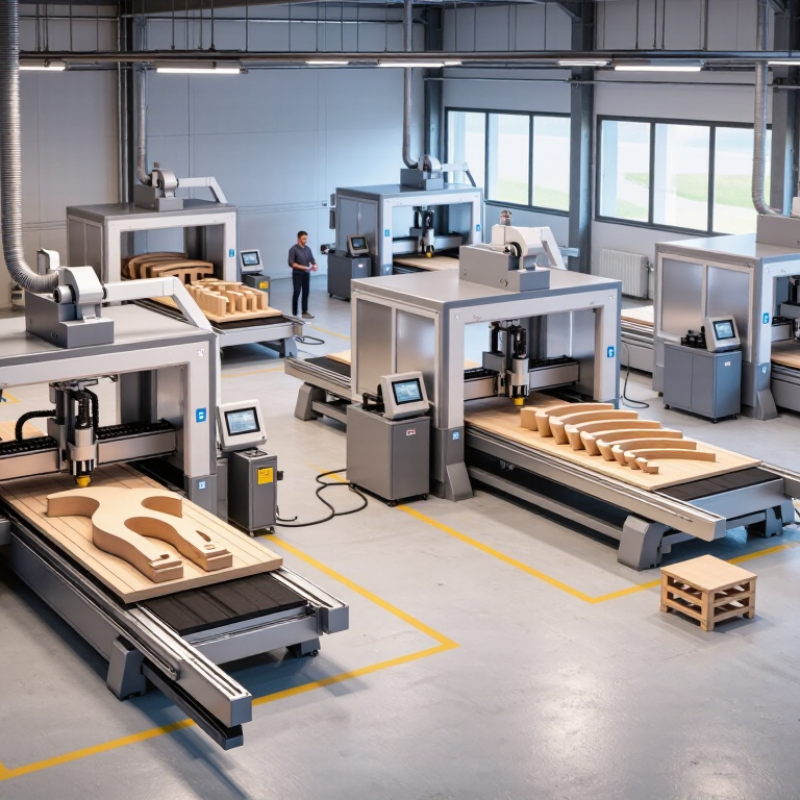
5-Axis CNC Selection Criteria: ±0.05 mm Accuracy, 6–12 kW Spindles
2026 Top 5 Axis Wood CNC Machines for Global Buyers
5-Axis CNC Selection Criteria: ±0.05 mm Accuracy, 6–12 kW Spindles
Choosing a five-axis wood CNC machine requires more than reading its advertised accuracy. A reliable machine should achieve ±0.05 mm positioning accuracy under controlled conditions. Ask for test reports, calibration records, and sample parts. Measure the same pocket twice. The results should remain consistent. Thermal stability also matters during long production runs. A rigid gantry, preloaded linear guides, and protected ball screws reduce unwanted movement. However, workshop dust can still damage neglected components.
Spindle power should match the material and cutting strategy. A 6 kW spindle suits detailed cabinet work and moderate hardwood machining. A 9–12 kW spindle handles deeper cuts, dense timber, and larger tooling more confidently. More power is not always better. It may increase electrical demand, heat, and tooling costs. Check the spindle’s continuous rating, speed range, cooling method, and runout. A practical target is below 0.01 mm runout at the tool holder.
I have found that rotary-axis rigidity often decides real-world performance. Test the machine with an angled chair part, not only a flat panel. Inspect edge quality around steep transitions. Confirm automatic tool changing, probing, dust extraction, and software compatibility before purchase. Global buyers should also verify voltage, training, spare-part access, and local service response. No machine stays perfect forever. Even a strong specification needs disciplined maintenance, careful fixturing, and periodic verification.
2026 Top 5-Axis Wood CNC Machines for Global Buyers
Comparison of representative 5-axis machine configurations using spindle power and stated positioning accuracy as key selection criteria.
Higher spindle power supports faster material removal and heavier cutting, while a smaller accuracy value indicates tighter positioning performance. The listed 6–12 kW range and ±0.02–±0.05 mm accuracy range represent commonly specified requirements for professional 5-axis wood CNC applications. Actual results depend on machine structure, calibration, tooling, material, and operating conditions.
High-Speed 5-Axis Router: 12 kW Spindle and 25–30 m/min Feed Rate
For the 2026 top five-axis wood CNC machines, spindle power and feed speed deserve close attention. A 12 kW spindle can maintain cutting force during heavy oak or laminated-panel work. The advertised 25–30 m/min feed rate also reduces air-cutting time. Speed matters. However, maximum feed is not the same as productive feed. Tool diameter, cutting depth, grain direction, and acceleration often limit real output.
MarketsandMarkets projects the global CNC machine market to grow from about USD 88 billion in 2024 to nearly USD 118 billion by 2029. Grand View Research also identifies automation and complex-part production as major growth drivers. These findings support stronger demand for five-axis routers in furniture, stair components, and sculptured woodwork.
During machine evaluations, buyers should request test cuts using their own timber. Check spindle load, surface quality, corner accuracy, and cycle time. A clean 12 kW rating means little if the machine loses rigidity during deep cuts.
The best candidates should combine 25–30 m/min travel with dependable acceleration and five-axis interpolation. A rigid gantry, accurate rotary head, automatic tool measurement, and stable dust extraction are practical requirements. ISO 230 testing principles can help verify positioning performance, although many workshops overlook them. I would also inspect post-processor support and local maintenance response.
That part is easy to underestimate. Faster cutting may expose vibration, chip evacuation problems, or weak vacuum zones. A slower trial can sometimes reveal more than a polished demonstration.
Global-Buyer Comparison: CE/UL Compliance, 380 V/50 Hz Power, and TCO
2026 Top 5 Axis Wood CNC Machines for Global Buyers
Global buyers should compare compliance before comparing spindle speed. CE marking indicates conformity with applicable European Union requirements, but it is not a universal quality certificate. UL evaluation depends on the exact electrical assembly, safety standard, and installation authority. Ask for the Declaration of Conformity, risk assessment, wiring diagrams, and test records. These documents matter more than a polished specification sheet.
Power compatibility can quietly change the purchase decision. A 380 V, 50 Hz machine may suit many industrial sites in Europe, Asia, Africa, and parts of South America. It may require a transformer or frequency solution in 60 Hz regions. Verify motor ratings, phase sequence, control voltage, and dust-collector capacity before shipping. An installation mistake can be expensive.
Total cost of ownership deserves a wider lens. Grand View Research estimated the global CNC machine market at about US$86.8 billion in 2023, showing strong industrial demand, although published forecasts differ. U.S. Department of Energy guidance identifies motor-driven systems as consuming more than half of industrial electricity in many facilities. Compare standby power, cutting efficiency, tooling life, maintenance intervals, freight, commissioning, software, and downtime. A cheaper machine may lose that advantage through unstable calibration or weak support. I would also question optimistic payback claims. Real workshops produce mixed materials, rushed jobs, and occasional operator errors. The comparison is never perfectly clean.